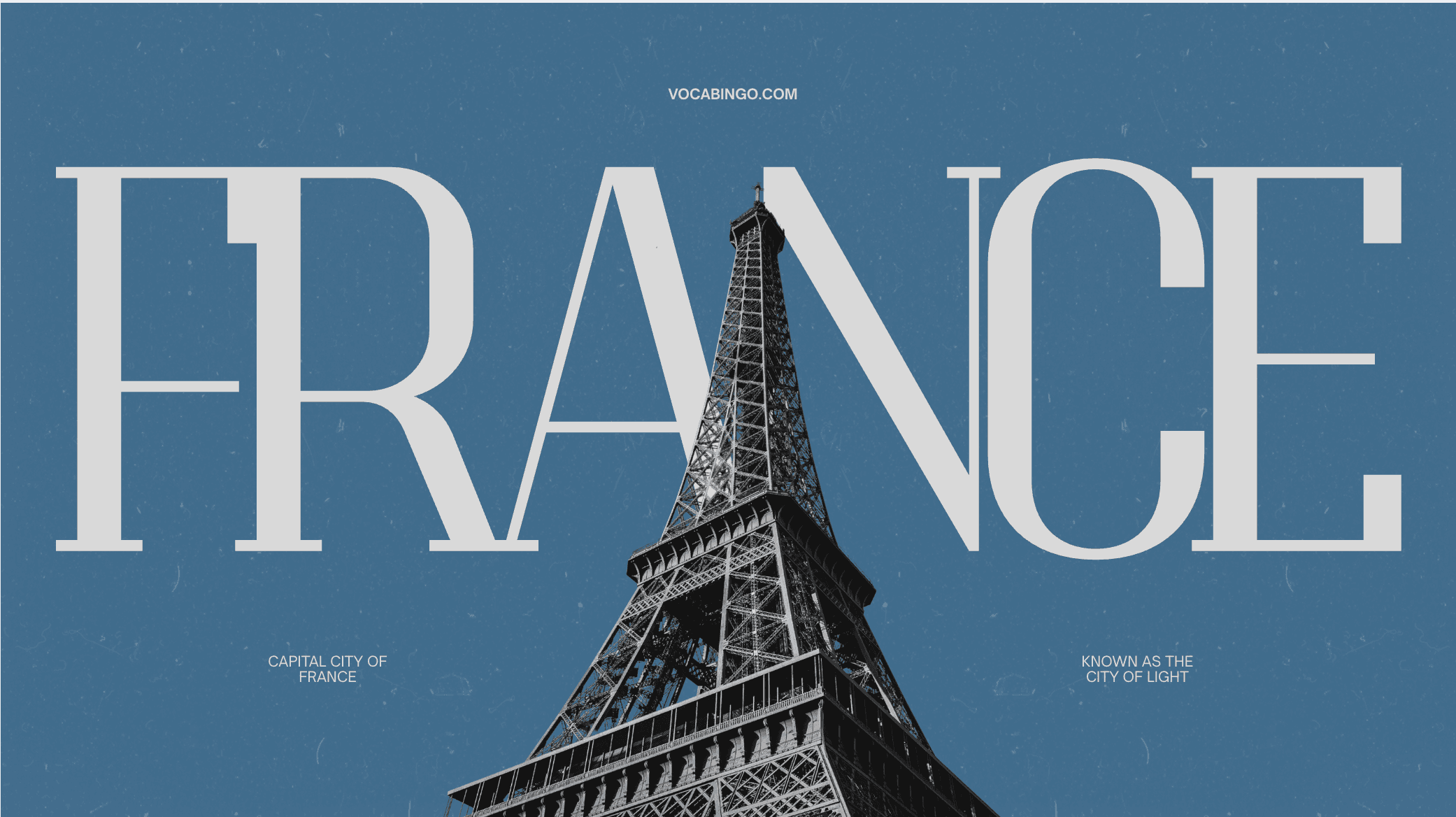
How to learn French vocabulary
A practical guide for English speakers - what to learn first, how to make it stick, and why spaced repetition beats every other method.
Start with the 2,000 most common words
French has roughly 100,000 words in active use, but the top 2,000 account for approximately 90% of everyday speech and writing. For an English speaker, this number is also particularly tractable: French and English share thousands of cognates through their shared Latin and Norman roots. Words like "nation", "communication", "information" are identical or near-identical. The real work is the 1,000 or so high-frequency words that don't cross over - verbs, prepositions, conjunctions, and common adjectives.
Why English speakers have an advantage with French
Around 30% of English vocabulary has French origins - a legacy of the Norman Conquest. This means you're not starting from zero. When you encounter French words ending in "-tion", "-ment", "-ible", or "-ique", you can often infer meaning from context. The flip side: false friends (faux amis) like "sensible" (which means sensitive, not sensible) require deliberate attention. Spaced repetition flashcards help here because they force you to actively produce the correct meaning rather than guess from similarity.
How spaced repetition accelerates French vocabulary
The SM-2 algorithm, used in Vocabingo, schedules each French word for review based on your recall quality. A word you remember confidently is pushed to a longer interval - 7 days, then 14, then 30. A word you forget resets to the next day. This means the time you spend reviewing French is concentrated entirely on words at the edge of your memory - not on words you already know, and not on words you've never seen. The result is roughly 3–4× more efficient than fixed-interval review systems.
Learn French words in context, not isolation
A French word studied alone is fragile. "Souligner" means "to underline" - but without context, that fact evaporates quickly. Study it in the sentence "Il faut souligner l'importance de ce problème" and you absorb not just the meaning but the verb's register, its typical grammatical environment, and a concrete usage scenario. Every word in Vocabingo's French library comes paired with an example sentence. Before you answer, the sentence appears with the word blanked out - giving you a clue without giving away the answer.
10 new French words per day is the right target
Learning 50 words in a session sounds productive. It is not. At that pace, the review debt compounds faster than you can clear it, and retention drops sharply after the first 20–30 items in a session. Research on vocabulary acquisition consistently shows that 10–20 new words per day, maintained consistently over months, produces better long-term retention than irregular binge sessions. At 10 words per day, you will have studied all 2,000 most common French words within 7 months - and by that point, you will genuinely know several hundred of them.

- 01
Learn high-frequency verbs "être", "avoir", "faire", "aller", "vouloir", "pouvoir" first - they appear in almost every sentence.
- 02
Pay attention to gender (masculine/feminine) from the start. Relearning gender later is harder than learning it with the word.
- 03
Use the pronunciation audio on every new word - French spelling and pronunciation are complex and must be learned together.
- 04
Don't skip filler phrases and connectors. Words like "donc", "alors", "quand même", "pourtant" are low-frequency in vocabulary lists but high-frequency in real speech.
- 05
Review daily. Even 10 minutes keeps the spaced repetition queue clear and the streak intact.
French vocabulary questions
At 10 words per day with consistent review, you can study all 2,000 most common French words in about 7 months. Genuine mastery (being able to produce them reliably under pressure) takes longer - expect 12–18 months for the full library to feel solid.