You have probably heard the joke. A Pole tells a foreigner, "Do not bother learning Polish - even we struggle with it." The joke is friendly, but it is also a warning. Polish is consistently ranked among the hardest languages in the world for English speakers - the US Foreign Service Institute puts it in Category IV, requiring roughly 1,100 class hours to reach professional fluency, compared to 600 for Spanish or French. And unlike Mandarin or Arabic, Polish opens the door to a country of only 38 million people, most of whom speak passable English. So the honest question is: is Polish actually worth the years of effort? This article tries to answer that seriously, without the tourist-board enthusiasm and without the doomer takes on Reddit.
The case against - stated plainly
Let us start with the arguments against, because they are real and any serious learner needs to weigh them before committing. Polish has seven grammatical cases (nominative, genitive, dative, accusative, instrumental, locative, vocative), three genders in the singular and two in the plural, aspectual pairs for almost every verb, palatalisation rules that mutate consonants when endings attach, and consonant clusters (szcz, pstr, wzgl) that break most non-Slavic tongues. There is no cognate cushion the way German or French offer English speakers. "Chair" is not "chair-ish" - it is "krzesło". Every noun has to be learned from scratch, and then declined in seven forms.
The economic case is also weaker than for the big lingua francas. Poland is a mid-sized European economy - a real one, growing fast - but the language of business inside multinationals in Warsaw is overwhelmingly English. If you want to work in a Warsaw tech firm, or in a Kraków shared-service centre, you can arrive with zero Polish and still be productive. In diplomacy, EU institutions, or academic Slavic studies, Polish carries weight. In most other careers, it carries almost none. And unlike Spanish (500 million speakers across two continents) or French (300 million with strong presence in Africa), Polish is spoken meaningfully in exactly one country plus a diaspora.
The case for - and why it is stronger than it looks
Now the other side, because the case for Polish is more interesting than the "utility calculus" suggests. First, the demographic reality. Polish is the second-most-spoken Slavic language after Russian, and the largest Slavic language in the European Union by native speakers. That matters if you live in the UK (where Polish is the second-most-spoken language after English), in Germany, in Ireland, in Chicago. If you work in construction, healthcare, education, or logistics in any of these places, Polish is not a niche - it is the daily language of a large portion of your colleagues and clients.
Second, the strategic linguistic value. Polish is a gateway Slavic language. Once you have internalised the case system, the aspect distinction, and the palatalisation patterns, you can read Czech and Slovak with real comprehension, follow Ukrainian and Belarusian with effort, and start Russian at roughly A2 level from day one. No other European language cluster offers this transferability. Learning Polish is not learning "one language" - it is buying a cheap onboarding into a family of languages spoken by roughly 300 million people across central and eastern Europe.
Third, the cultural payoff is genuinely large and undersold. Polish literature is one of the great European traditions - four Nobel laureates in literature (Sienkiewicz, Reymont, Miłosz, Szymborska, and a fifth if you count Tokarczuk in 2018) and a poetry tradition that survives translation poorly. Polish cinema - Kieślowski, Wajda, Pawlikowski - relies heavily on register, silence, and dialect that subtitles flatten. Polish music, from Chopin's letters to contemporary hip-hop, opens up completely once you have the language. If you care about central European history - the interwar period, the Warsaw Uprising, the Solidarity movement, the post-1989 transformation - primary sources are overwhelmingly in Polish.
The cognitive science angle
There is a separate argument worth taking seriously: Polish is hard in ways that appear to be cognitively productive. Studies on bilingualism (Bialystok and colleagues at York University, among others) consistently find that learning morphologically complex languages - languages where you constantly track case, gender, and aspect - correlates with stronger executive function, better working memory, and delayed onset of dementia symptoms. This is not a reason to learn Polish specifically, but it is a reason to reject the common "just pick something easy like Dutch" advice. If you are going to spend three years on a language, the harder language may return more cognitive interest.
The other cognitive angle is more subjective but real. Polish forces you to think about grammatical relationships that English simply does not encode. When you say "I gave the book to the woman" in Polish, you mark the woman as dative, the book as accusative, and the verb as perfective if the giving is completed. Every sentence forces you to specify things English speakers can leave vague. Many long-term learners describe a genuine shift in how they perceive events, agents, and completion - not a Sapir-Whorf fantasy, but a real change in the granularity of attention.
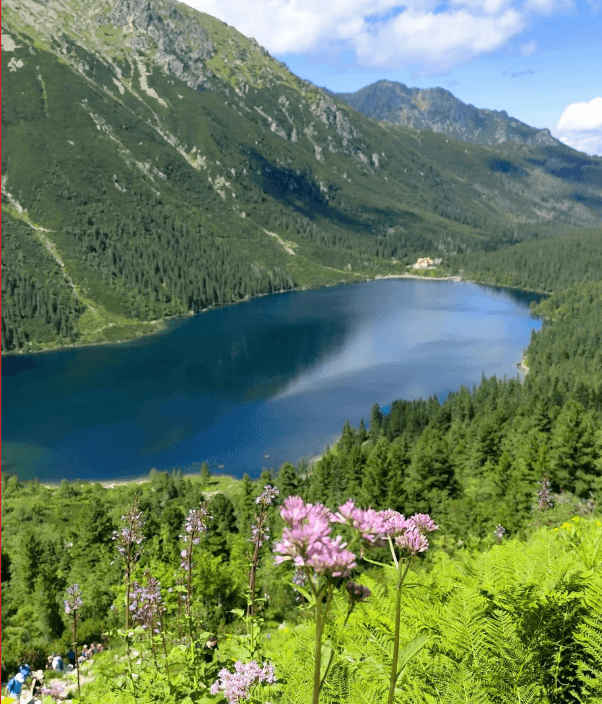 Morskie Oko · Tatra Mountains
Polish is a gateway Slavic language — a cheap onboarding into 300 million speakers.
How hard is it, really?
Honest numbers. FSI Category IV puts Polish at 1,100 hours of instruction to reach S-3/R-3 (working professional proficiency) for a motivated English-speaking adult. That is roughly three years at one hour per day, or eighteen months at two hours per day. Compared to Spanish (600 hours) or German (750 hours), you are looking at roughly double the time investment for equivalent proficiency. The first six months are the steepest - the case system, verbal aspect, and pronunciation all hit at once, and there is almost no free vocabulary from English. After the first year, most learners describe a plateau that gradually resolves as the patterns become automatic.
The good news, and it is significant: Polish spelling is almost perfectly phonetic. Once you learn the fifteen or so sound-letter mappings, you can pronounce any written word correctly. There is nothing like French silent letters or English orthographic chaos. Word order is flexible because cases carry the meaning, which means you can get sentences wrong grammatically and still be understood. And Poles are, in general, extraordinarily encouraging of foreigners who try - a mispronounced "dzień dobry" from a foreigner earns real warmth, not the polite tolerance you get in Paris.
Who should learn Polish
Who should probably not
The verdict
Polish is worth learning if you have a real reason - a person, a place, a body of literature, a career niche, or genuine intellectual pull. It is not worth learning as a generic self-improvement project or a "next language after Spanish" for someone who just wants another entry on the CV. The time investment is roughly double what easier European languages demand, and the utility outside Poland and the diaspora is genuinely limited. But the cultural, cognitive, and Slavic-family payoffs are large enough that, given a real reason, Polish rewards commitment as generously as any language on earth.
The most honest recommendation: do not decide from the outside. Give yourself thirty days of serious daily practice - twenty minutes on core phrases, ten on the sound system, and one small conversation with a native speaker per week. At the end of the thirty days you will know two things. First, whether Polish clicks for you as a system (some brains find case languages exhilarating; others find them exhausting). Second, whether the culture pulls you in enough to justify the years ahead. If both answers are yes, commit fully. If either is no, no shame in stopping - you will have learned enough tourist Polish to be gracious in Warsaw, and you will have made an informed choice instead of a romantic one.
A different language is a different vision of life.
 Pierogi, dusted with flour